American Sovereign Intelligence · Lucid Lock · Live on the App Store
From Lost Dreams to the App Store
A dream journal that lives on one phone, trains you from your own data, and never phones home. Built, tested and shipped in six weeks. The privacy wasn't a feature bolted on at the end. It was the reason the app exists.

Whisp says
Hi. I'm Whisp. In Lucid Lock I greet people on their first morning. Today I'm greeting you.
Tap Whisp
The 30-Second Version
Here's the whole thing, fast.
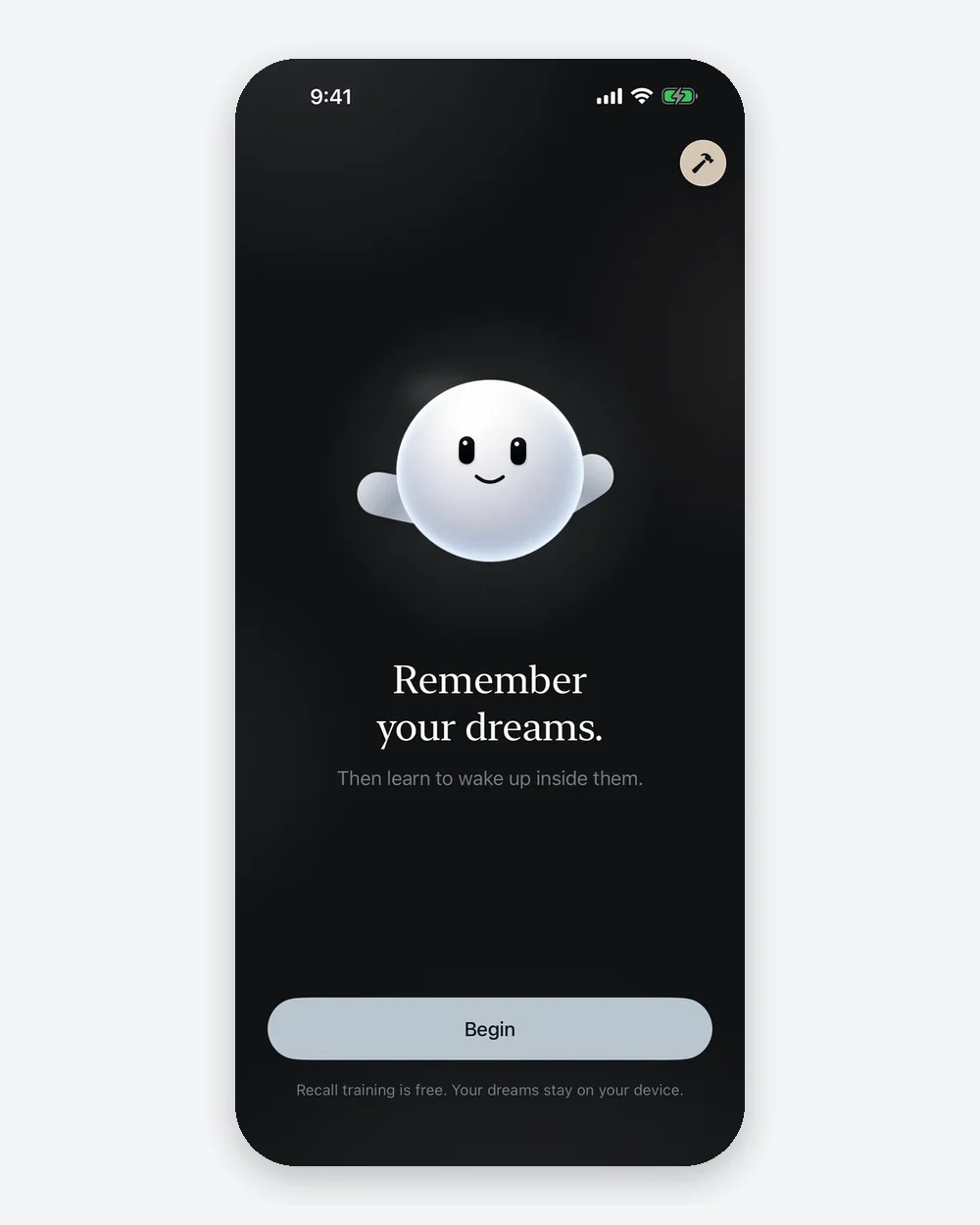
Then privacy went from a slogan to an architecture.
And Whisp went from a character sheet to a character. Go ahead, tap him.
Sovereign by construction
Local storage. Local intelligence. The user holds the only copy.
Sovereign intelligence is a simple idea: the software working on your behalf should run on hardware you own, over data you hold, with no third party in the loop. Lucid Lock is what it looks like at the scale of one person's phone and the most private thing they will ever write down.
Ayden built the app because he lost years of recorded dreams when he changed phones, and a journal that depends on somebody else's server is a journal that can disappear.

01
Stored on the device
02
Zero third-party dependencies
03
Speech never leaves the phone
04
Patterns computed locally
05
Export and delete, for real
06
Sync is the user's call
Meet Ayden

Ayden Springer
Founder, PixelNova LLC · Built Lucid Lock
Ayden lost years of recorded dreams when he switched phones, and the app he wished he had been using didn't exist. Lucid Lock is that app, built under PixelNova LLC over the summer of 2026, from an AI gauntlet-loop first draft to a designed, tested, shipped product.
The methodology he came out with is the reusable asset: visual exploration first, then a specification, then an interactive prototype, then deliberate implementation, automated tests, manual tests, real-user tests, and models only where they are dependable. He had already built an audience once, on YouTube, and learned at launch that an audience doesn't transfer. Distribution has to be built on purpose, the same way the product was.
“AI can gladly build whatever you want, even in wildly the wrong direction. What I do is take real problems I run into and turn them into a solution. It turns out I was not the only one with the same problem.”
The Full Story
Every image on this page is a real artifact: brand boards, rejected screenshot sets, tester feedback, and the shipped screens.
Phase 1
Years ago, Ayden changed phones and lost every dream he had ever recorded.
He had been using a dream-journaling app and genuinely valued what was in it. The dreams got lost because the export was incomplete. The original idea was personal: build the journal he wished he had been using, where the history belongs to the user, is stored privately, and can be exported, imported, or recovered instead of vanishing with a device or a startup.
“Your dreams should not disappear because you changed phones or your app didn't let you export it.”
— Ayden, on why the architecture looks the way it does
Phase 2
Then the idea grew from dream journal into training.
Once the journal was structured data instead of text, the larger opportunity was obvious. Someone trying to lucid dream accumulates recurring people, places, emotions, dream signs, failed reality checks, techniques that worked, and recall quality.ad Instead of the same generic advice for everyone, that history could teach a person what works for them. The journal became the foundation of a training system rather than the product itself.
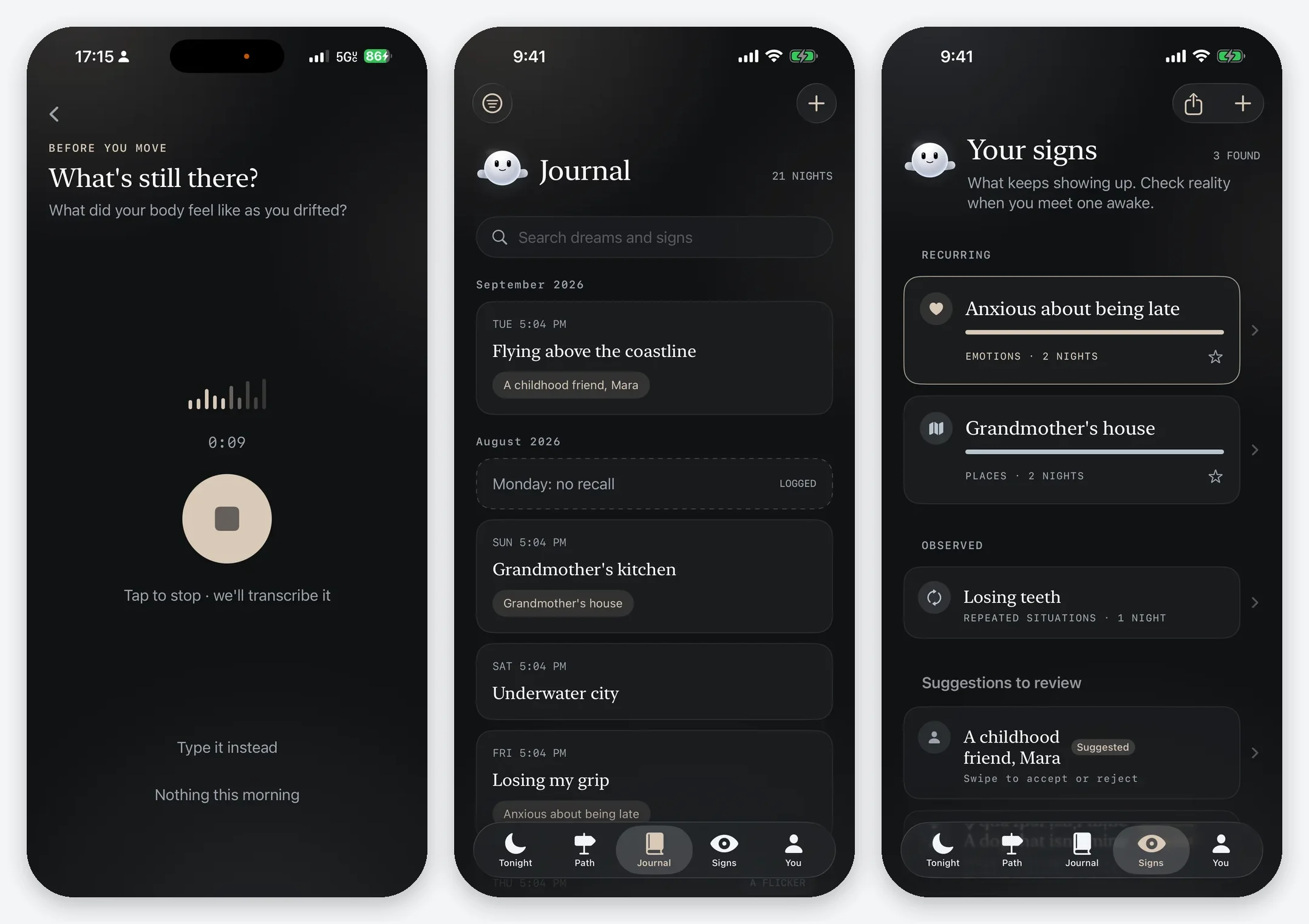
Capture, journal, signs. The free tier, as shipped. Stage one of the training is recall, and recall is free forever.
Phase 3
Summer 2026: the first build was an AI gauntlet loop. It produced a lot of software before anyone had decided what software should exist.
The first implementation was not carefully architected. Ayden gave an agent a goal and iterated on whatever came back. That got things moving fast, and it produced the most important lesson of the project: AI can build the wrong product very quickly. Turning that experiment into a real application took roughly six weeks of rewrites.
Aug 4
First commit, iOS repo
39k
Lines of Swift
440+
Test cases
0
Third-party packages
Phase 4
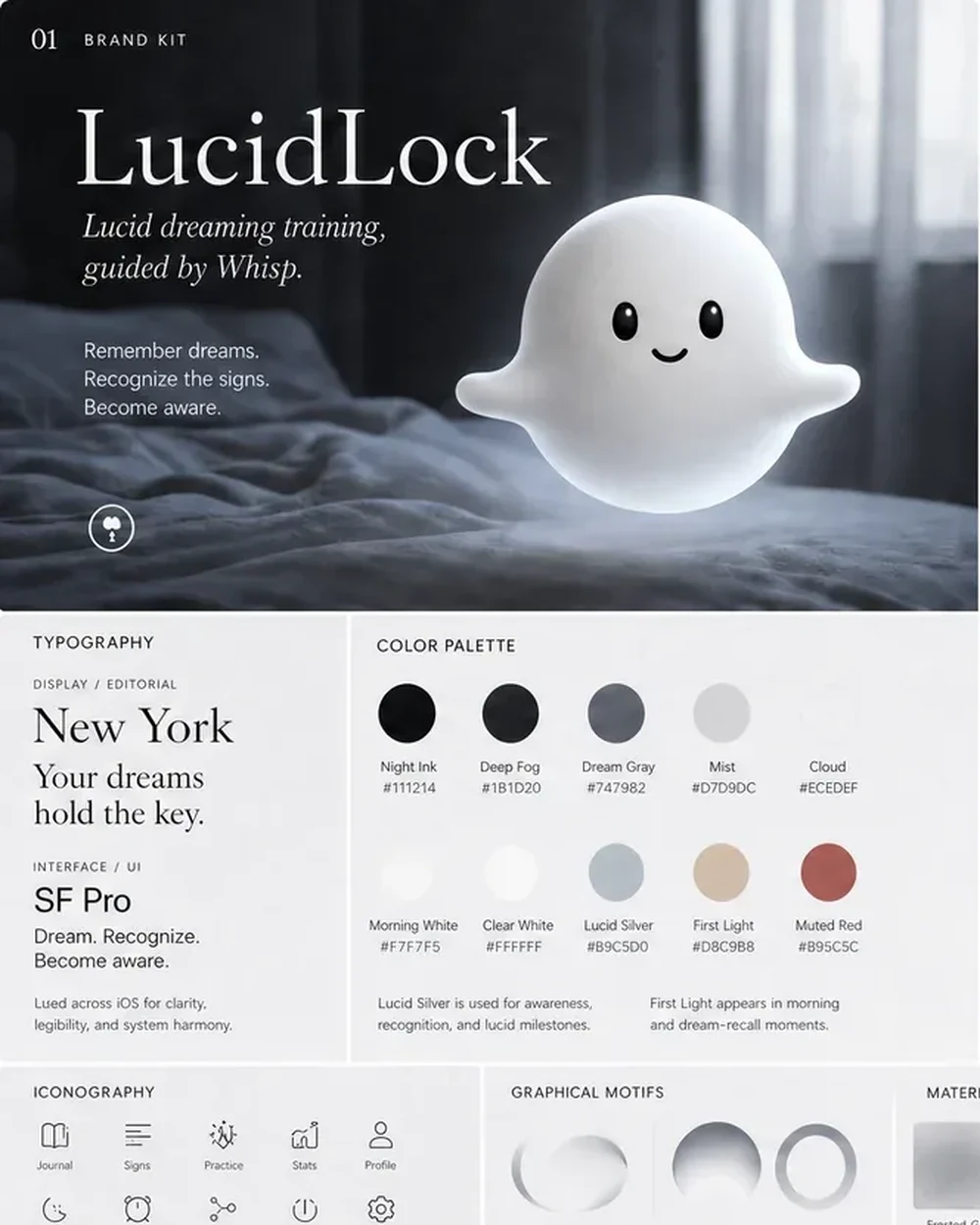
So design moved ahead of implementation. One brand board set the visual language before production code changed again.
ChatGPT Image was used to explore directions and produce a full brand kit: logo system, palette, typography, iconography, motion language, and Whisp's construction and expression sheet. Claude-driven prototyping then established screens, onboarding and interactions before the app was touched. Specifying the experience first cut the expensive downstream rewrites.
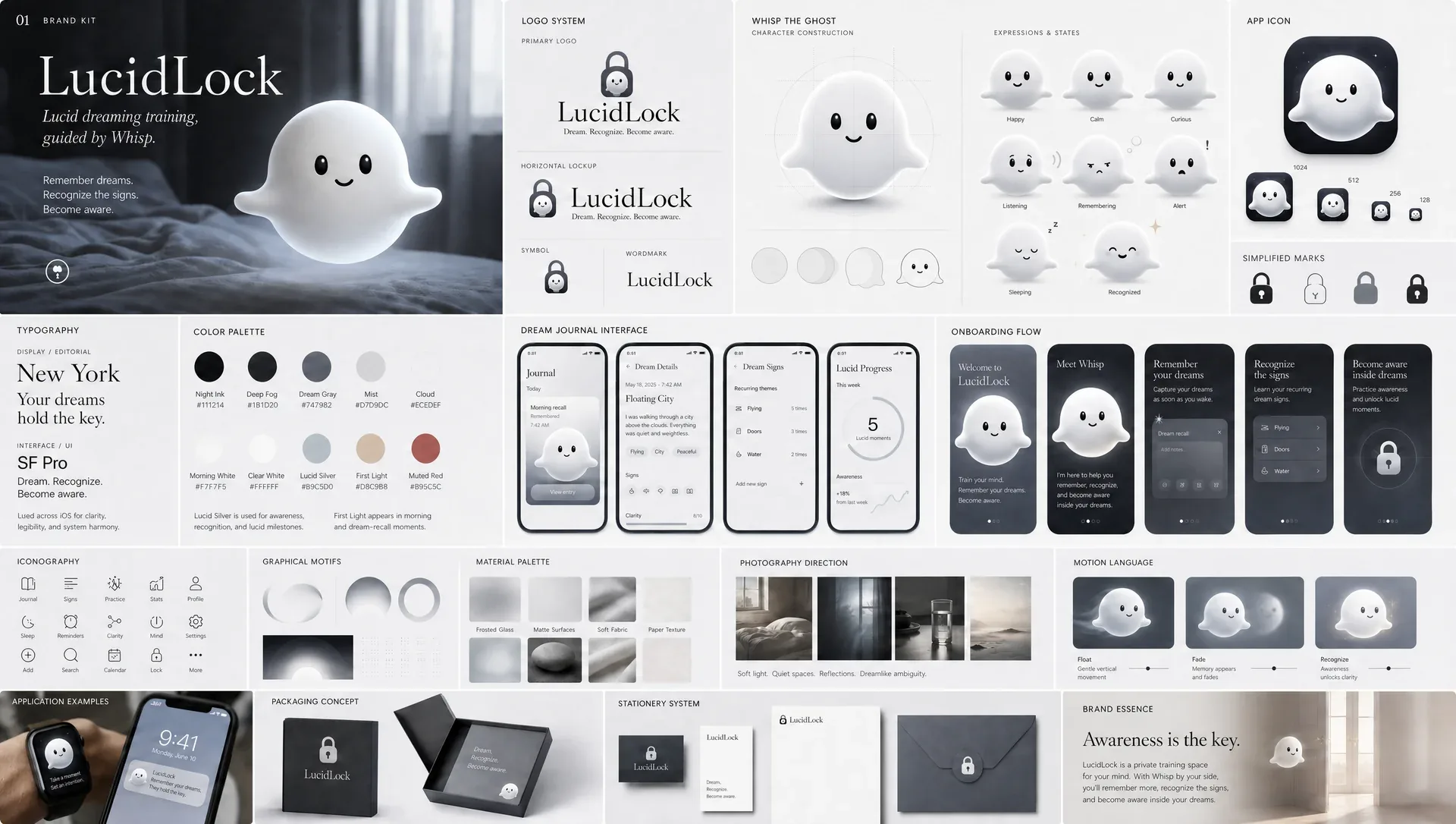
The board. Night Ink #111214, Lucid Silver #B9C5D0 and First Light #D8C9B8 are the exact values in the app's LucidColor.swift today.
Phase 5
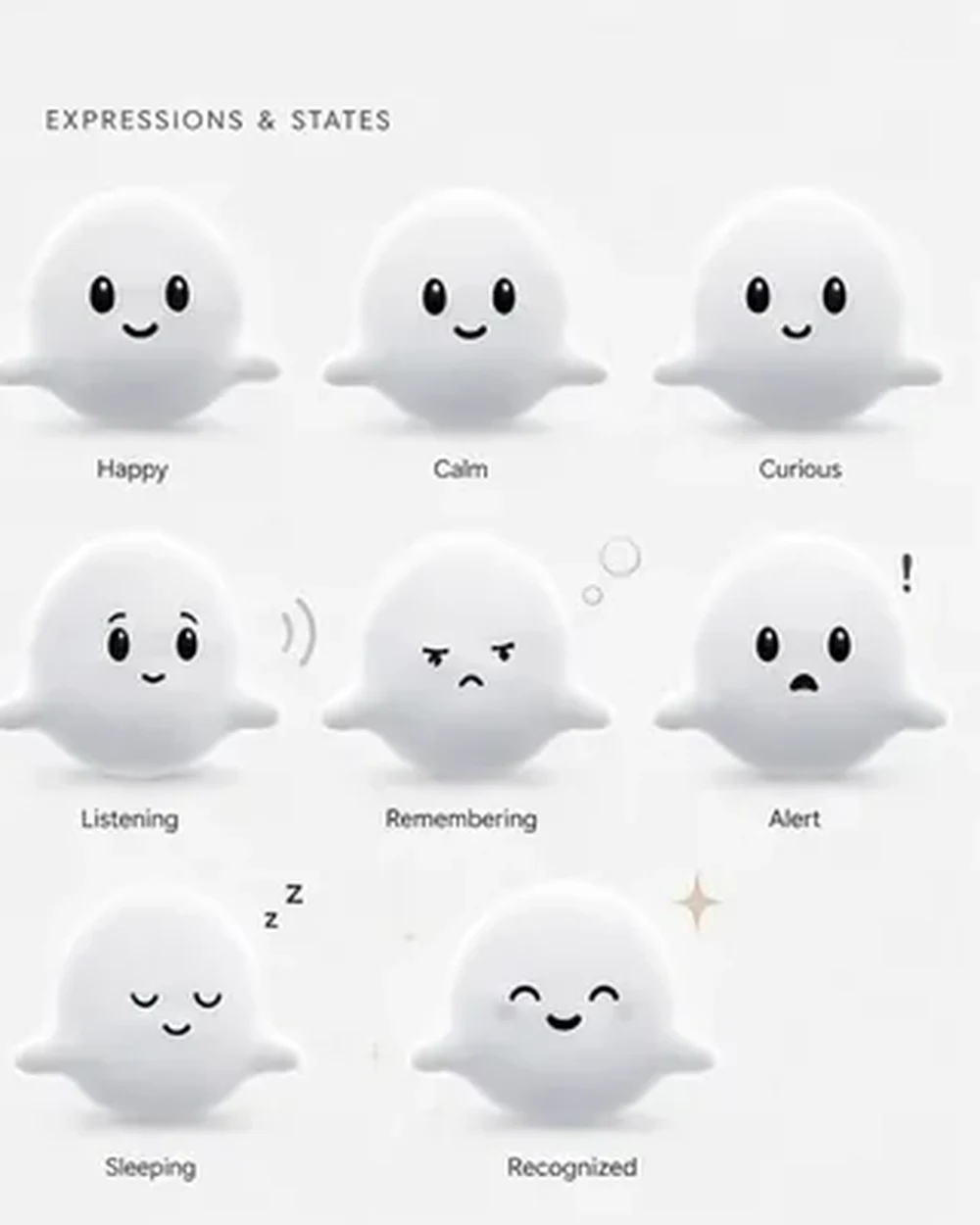
Whisp took two days. The AI could generate a hundred variations. It could not decide what Whisp meant.
Whisp was never going to be a chatbot or a virtual pet. He is a visual guide that makes a clinical subject feel less clinical and gives the app a face. Ayden iterated unusually deeply on proportions, movement and presentation because small character details changed the personality of the whole product. The rig you see on this page is a layered character, not an image: the body, arms, face, specular light and ground shadow move independently, with an idle float, a breath, a blink cycle, and seven reactions ported value-for-value from the Swift source.
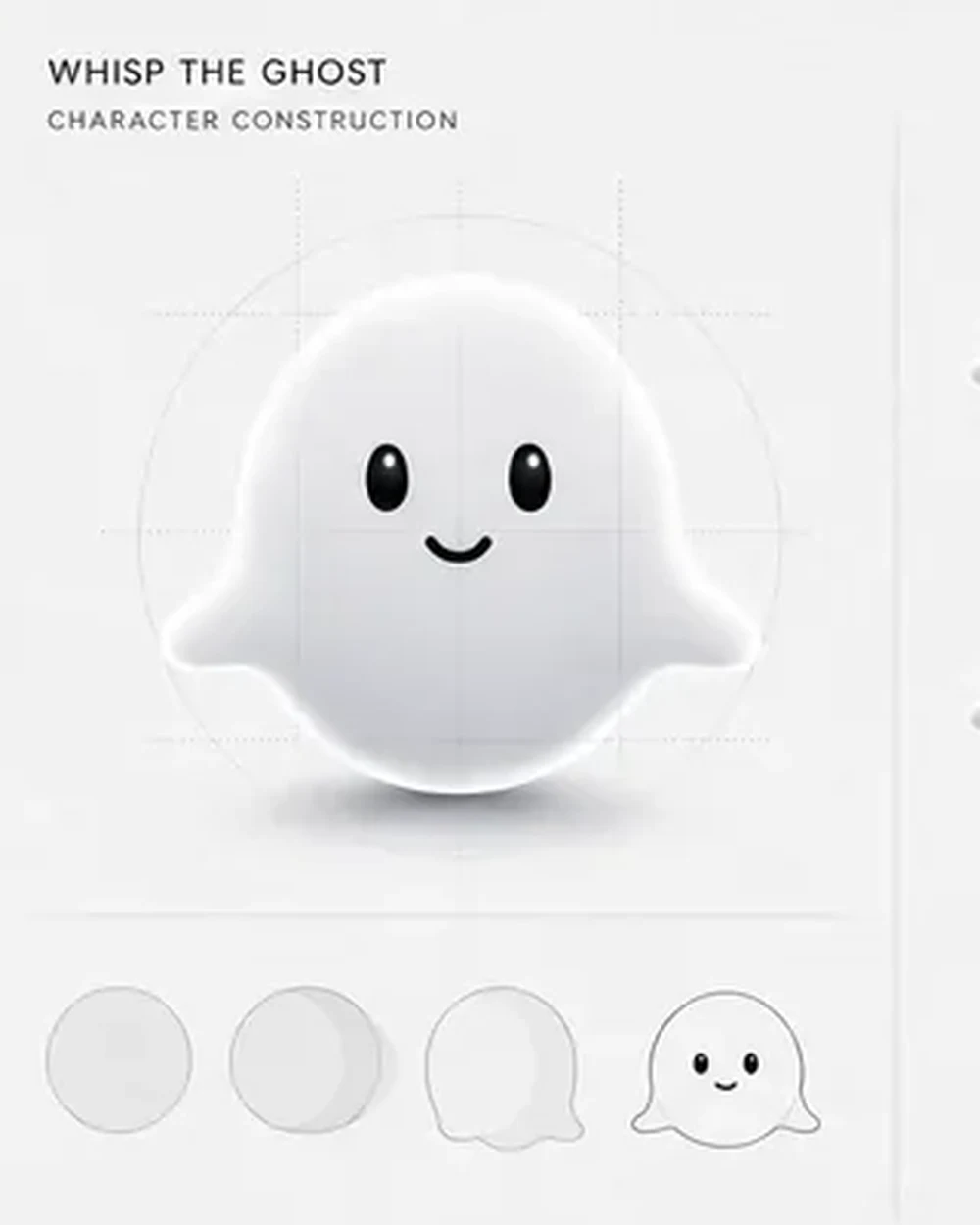
Board, expressions, shipped. A comment in the rig explains why the face scales with an exponent under one: so a 58pt Whisp and a 236pt Whisp read as the same character.
Phase 6
The product strategy became recall first. Most people fail at lucid dreaming because they can't remember their dreams.
Instead of throwing advanced techniques at a new user, stage one builds recall and keeps the journal useful. The free product covers recall and journaling. Lucid Lock Pro is the adaptive training layer: a nightly practice chosen from that morning's entry, dream signs, MILD or SSILD picked from the user's own recall baseline, a review every seven practice nights, and Insights. The principle that came out of it: recall is free, the program is the subscription.
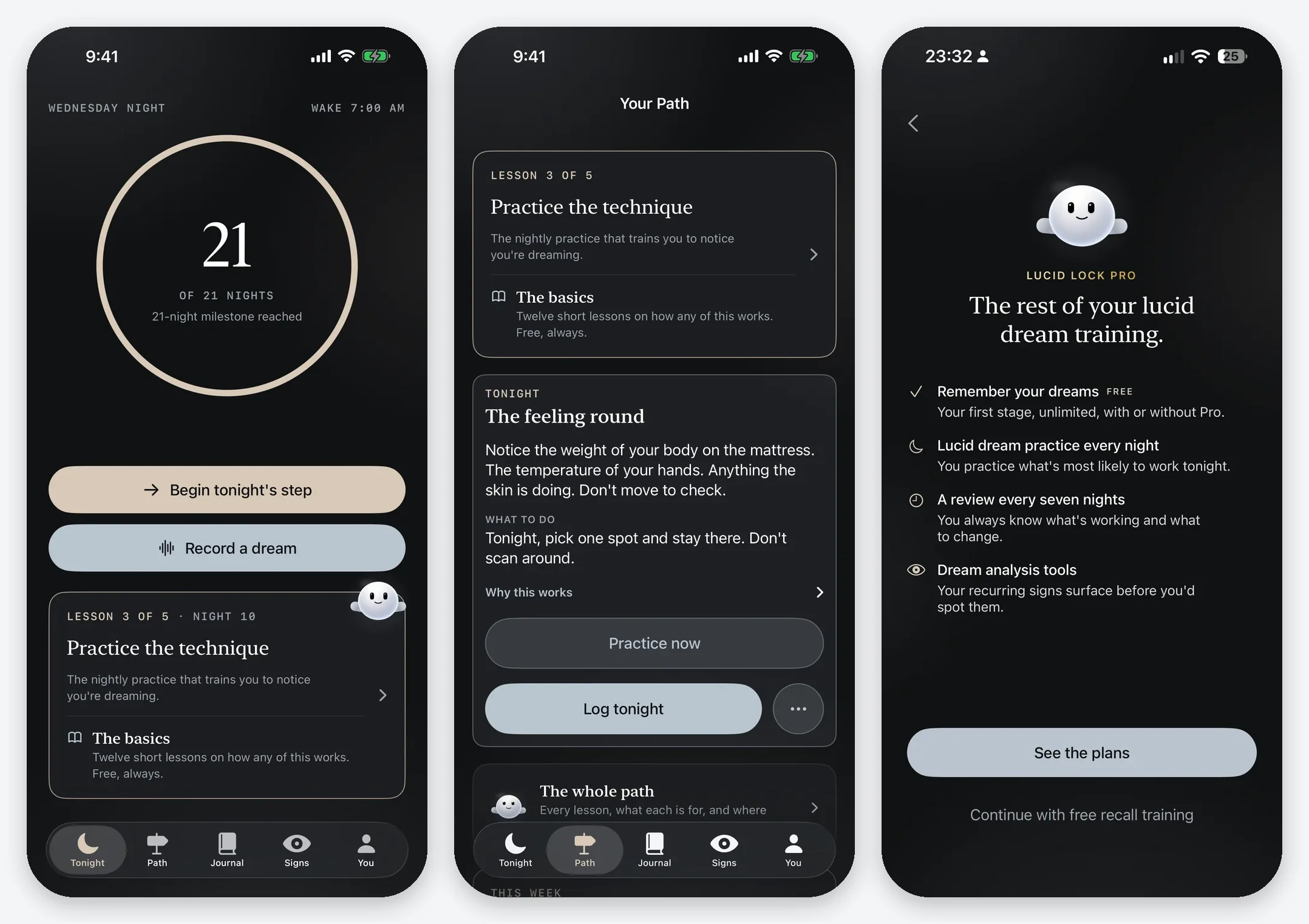
Tonight, Path, and the boundary. The step is offered at the edge of the free stage, not withheld. There is no paywall gate anywhere in the app.
Phase 7
Personalization turned out to be harder than adding AI. The small on-device models were unreliable, so they didn't ship as the foundation.
The original ambition was to analyze dreams with Apple's on-device intelligence and generate personal observations. In practice the small models were inconsistent at reading entries. Ayden tested generated Whisp notes and coaching, then chose not to make unreliable generative analysis load-bearing. Production uses deterministic pattern matching and structured signals first, with NaturalLanguage embeddings for recurring situations and Apple Intelligence only phrasing results where present. The generated note stays behind a flag that is off in release. It's a mature call: he removed impressive technology when it didn't reliably improve the product.
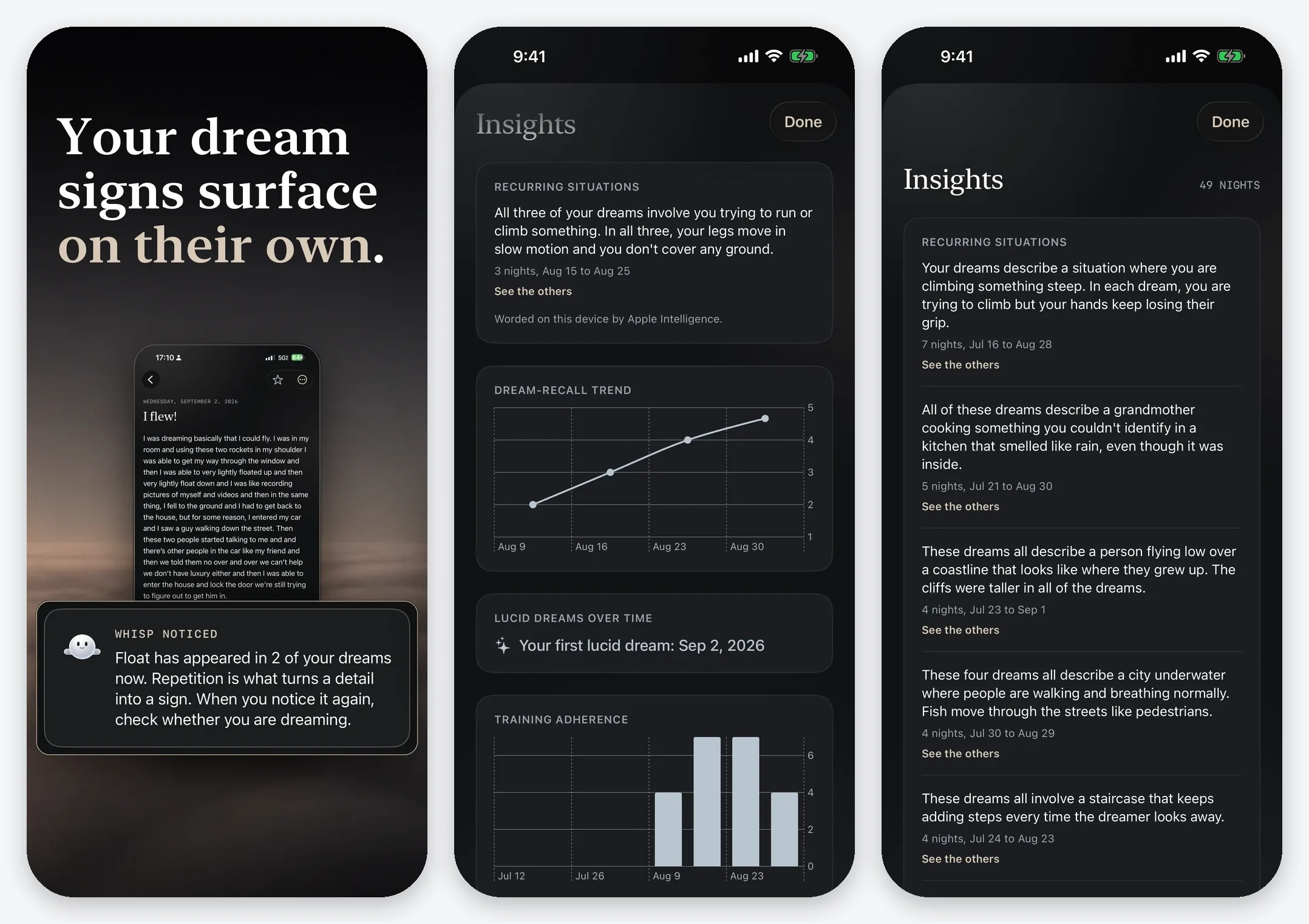
The two Insights screens had to be captured on a real iPhone. The recurring-situations engine needs on-device language assets that no simulator has, which is the honest cost of keeping the intelligence local.
Phase 8
The wound stayed in the architecture. No server, no account, nothing leaves the phone.
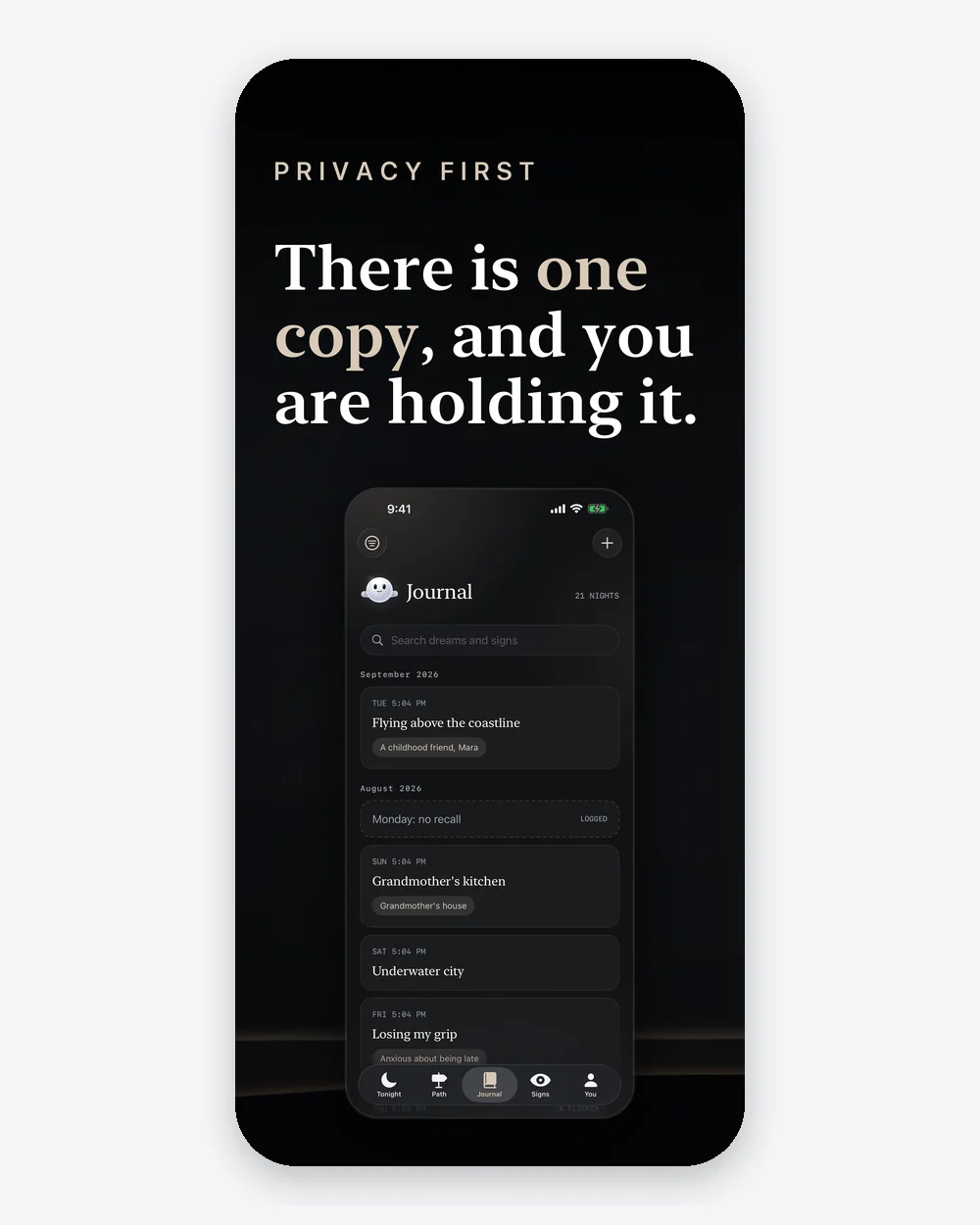
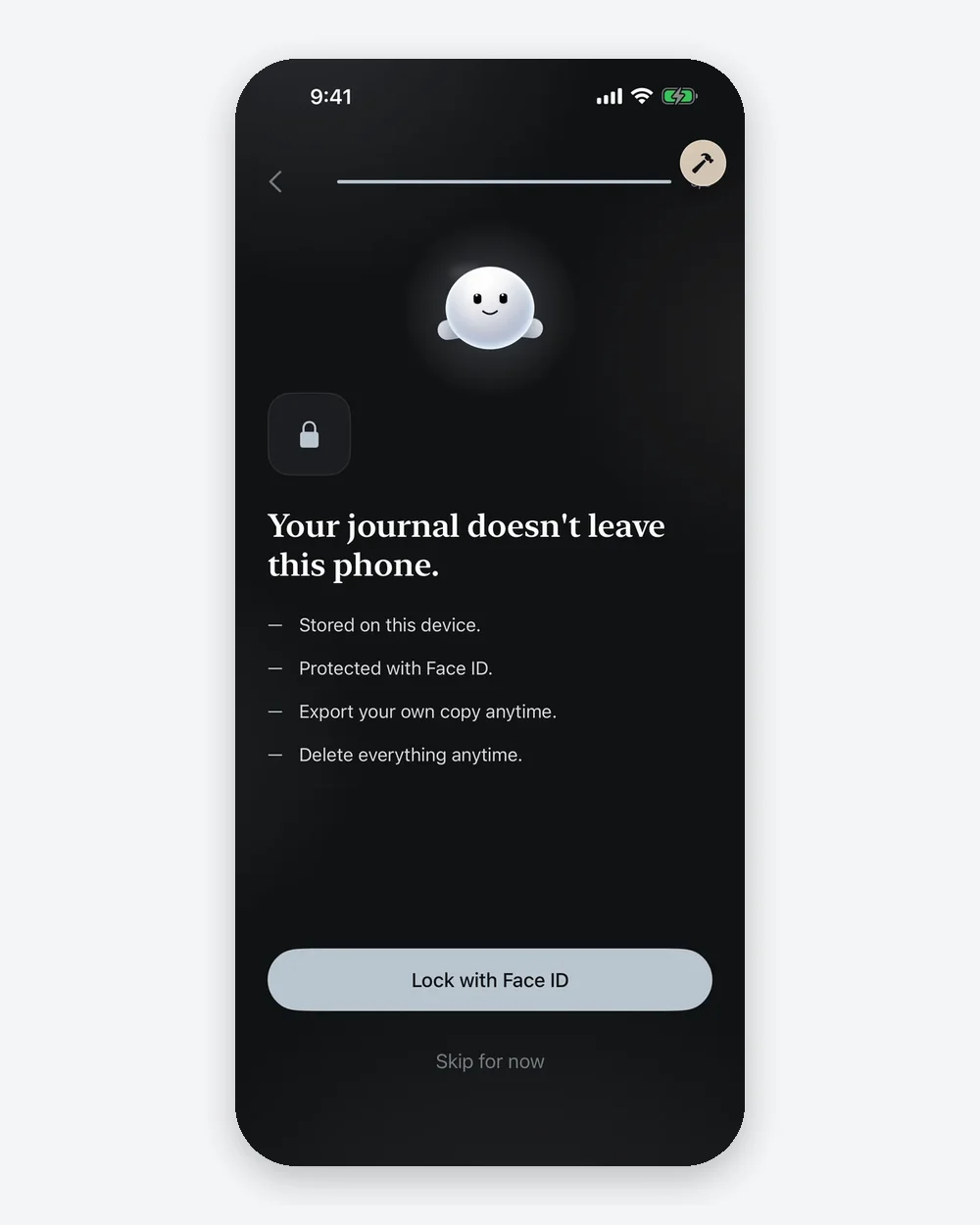
Privacy and data ownership came directly from the event that caused the app. Local persistence, export and import, Face ID, a full delete, and an iCloud sync that only ever goes to the user's own account. There is no service whose usefulness depends on Ayden's server staying online, because there is no server.
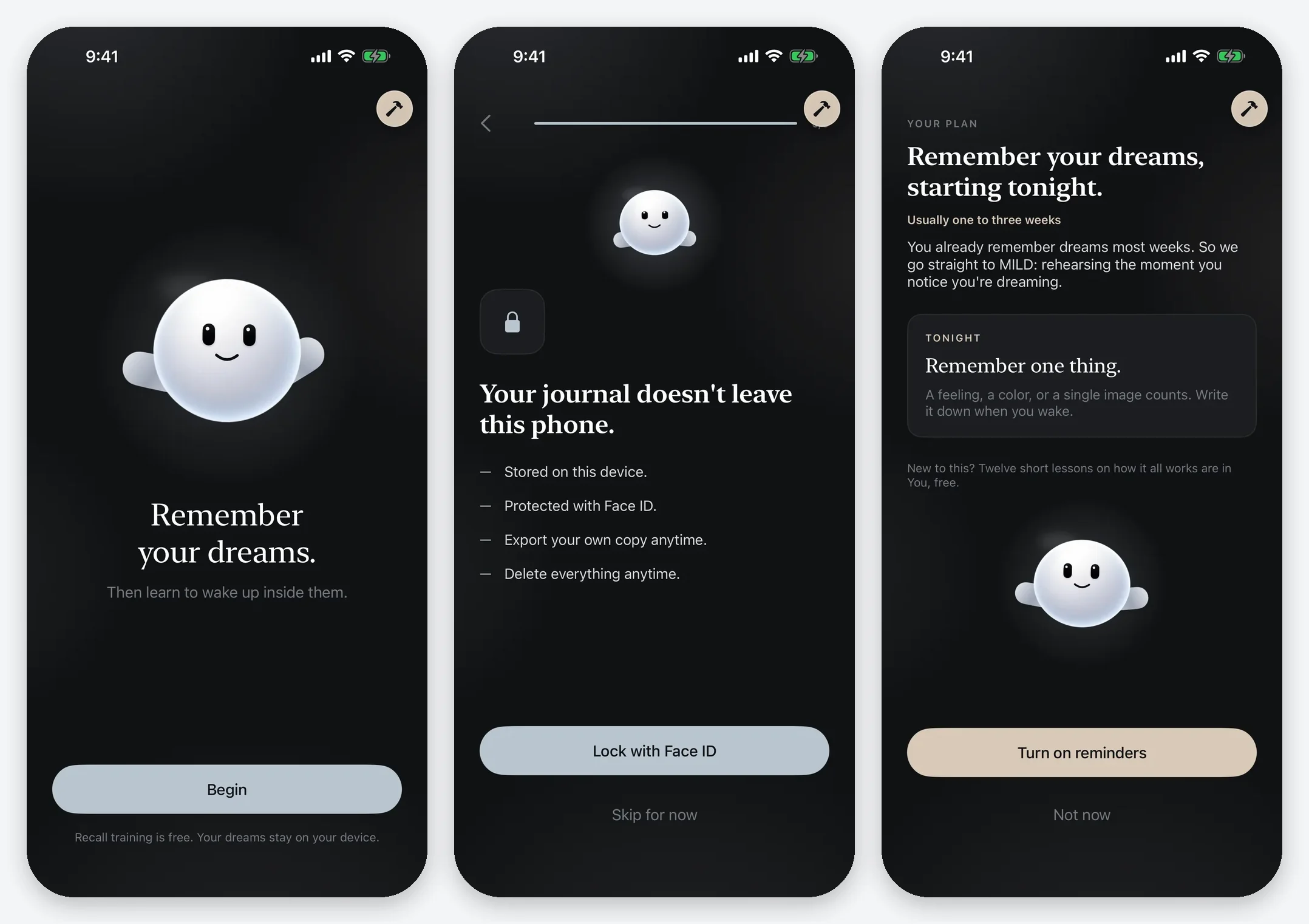
Welcome, privacy, plan. The privacy screen is a list of four true sentences and a Face ID button.
Phase 9
Real users changed small decisions. One tester read a back chevron as a paywall.
Testing exposed what Ayden's own use never could. On the onboarding subscription screen, the chevron he understood as an exit read as ordinary back navigation to someone else, so she concluded the app required payment simply to keep a journal. That misreading led to naming the paid layer Lucid Lock Pro, a visible labelled decline button, an explicit screen saying the journal is unlimited and free forever, and removing promises about how quickly anyone becomes lucid, because the app cannot honestly guarantee it.
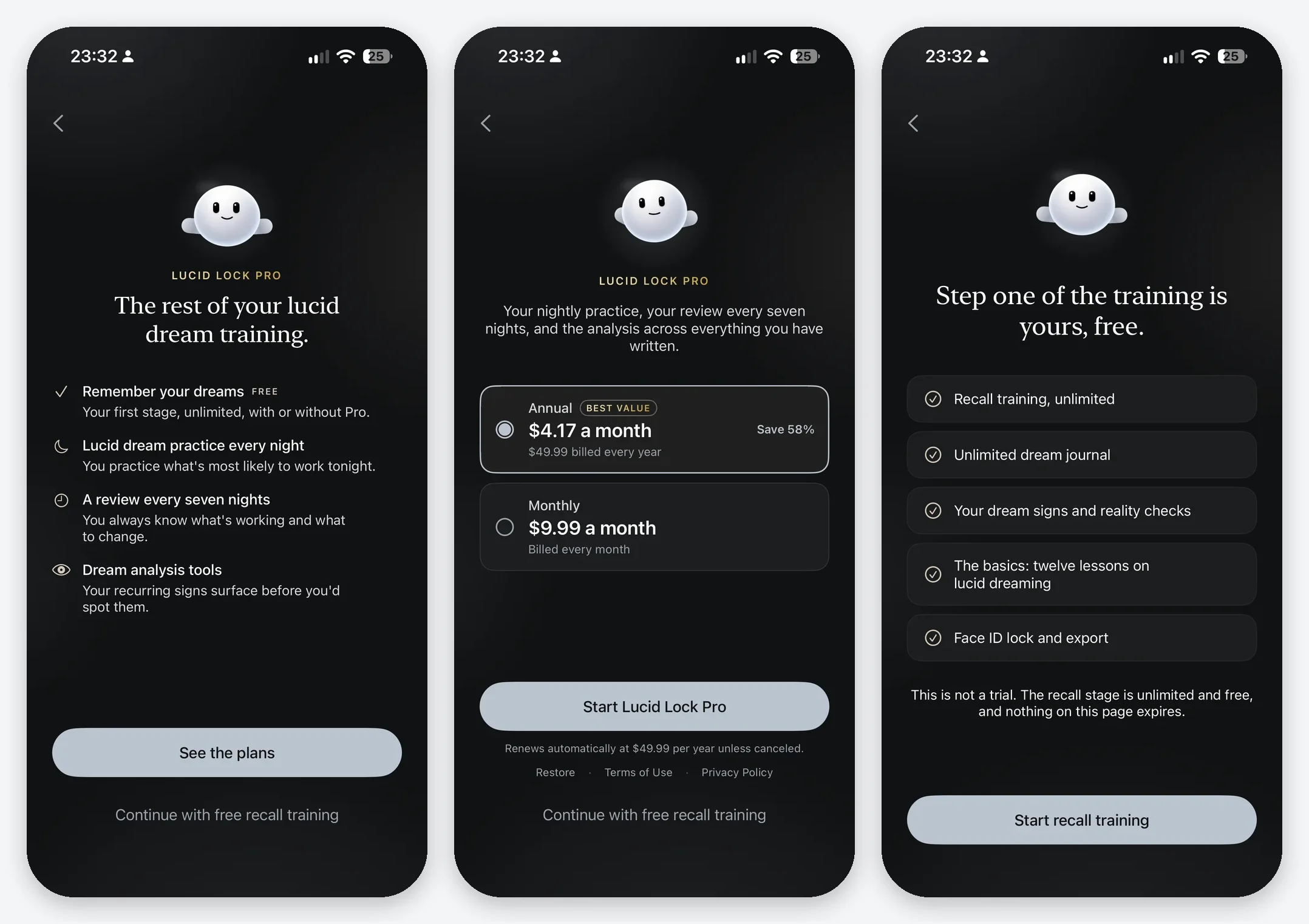
The pay flow as it shipped after that feedback: the Pro pitch, the paywall, and the screen you land on if you skip it. Every step has a way out, and the free stage is spelled out rather than implied.
“Why do I have to pay for a dream journal when I can just spit it into ChatGPT and get an analysis?”
— Beta tester, 27 Aug 2026.
Phase 10
August 27: monetization got grounded. $49.99 a year, monthly cut from $12.99 to $9.99, and no free trial.
The higher monthly number created too much friction against comparable consumer wellness apps. A conventional trial was rejected on purpose: users experience the recall system for free and meet Pro only when they reach functionality that actually requires the training system. That is a more defensible paywall than locking the journal after a few days.
$49.99
Pro, per year
$9.99
Pro, per month (was $12.99)
0
Free trials
∞
Journal entries, free
Phase 11
Six App Store screenshot sets before one shipped.
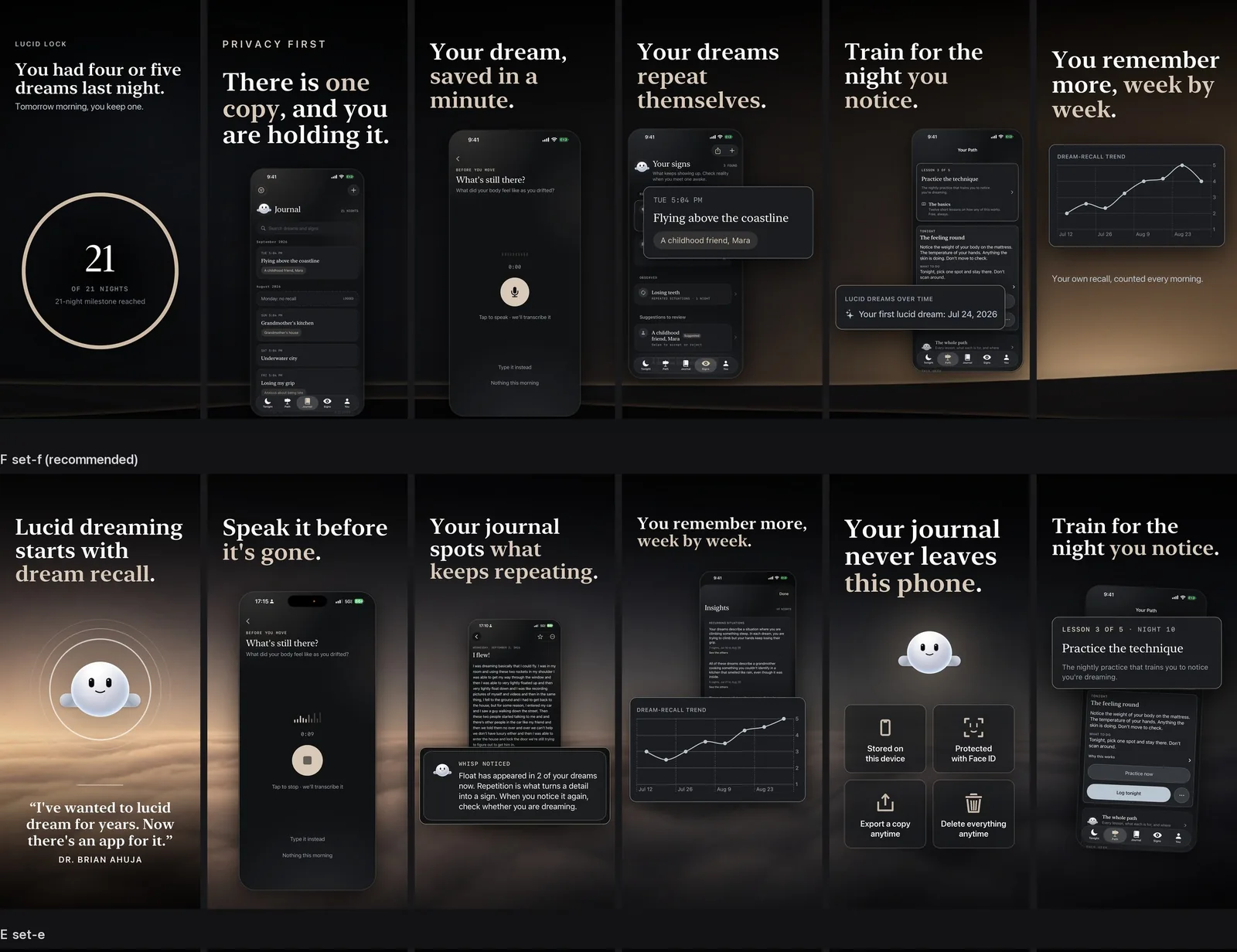
The listing got the same treatment as the product. Sets A through F each have a written plan and a build script. Set A opened on a milestone ring that said nothing at thumbnail size. Set F opens on a real tester quote with written permission behind it, states the privacy claim in a form a competitor can't copy, and reads in order as a course. Frame 4 is composited from two physical-device captures because the pattern engine won't run on a simulator.
6
Sets designed
36
Frames built
6
Frames shipped
1
Real quote, with permission
Set A, then set F. Same product, same six-frame shape. The captions were rewritten once more on Sept 8 before upload; the shipped set is in the finale below.
Phase 12
Then the harder problem showed up: distribution.
By late August the app was in good shape and almost nobody could find it. Instagram, TikTok, X and YouTube experiments ran in parallel: dream phenomena, relatable dream problems, lucid-dream education, static versus video. A new Instagram account was permanently banned. TikTok results swung wildly post to post. Atlanta Tech Week showed the subject has real pull, with people pulling Ayden aside to talk about lucid dreaming and early testers coming out of those conversations. An existing YouTube audience built on Mario and game development did not transfer. Building a product and distributing one turned out to be almost separate disciplines. The one channel that is fully under his control is the website, lucidlock.co, which carries the same privacy claims as the listing and links straight to the App Store.



Three of the dreamscape b-roll frames from the marketing bank. Marketing is being treated as experimentation rather than announcement.
Phase 13
September: the administrative side nearly became its own project.
Subscriptions, App Store Connect agreements, forming PixelNova LLC, converting the developer account into an organization, D-U-N-S, banking, tax, a business address, a support inbox, screenshots, metadata, TestFlight, and protecting production data while continuing to test. Ayden was using Lucid Lock as his own dream journal the whole time, so destructive testing could destroy data he actually cared about. The app was technically finished before every administrative dependency was resolved.
“App Review rejected the first submission on 2026-09-11 because an app with auto-renewable subscriptions has to carry a working Terms of Use link in the metadata.”
— LISTING.md
Phase 14
September 14–15, 2026: approved. Lucid Lock is on the App Store.
After the metadata fix, Apple reviewed the build quickly and approved it without a prolonged rejection cycle. It moved to Ready for Distribution. The project is no longer an app being built. It's a product a stranger can install, and the question it can now answer is the one nothing before launch could: whether people stay. It's live at lucidlock.co and on the App Store.
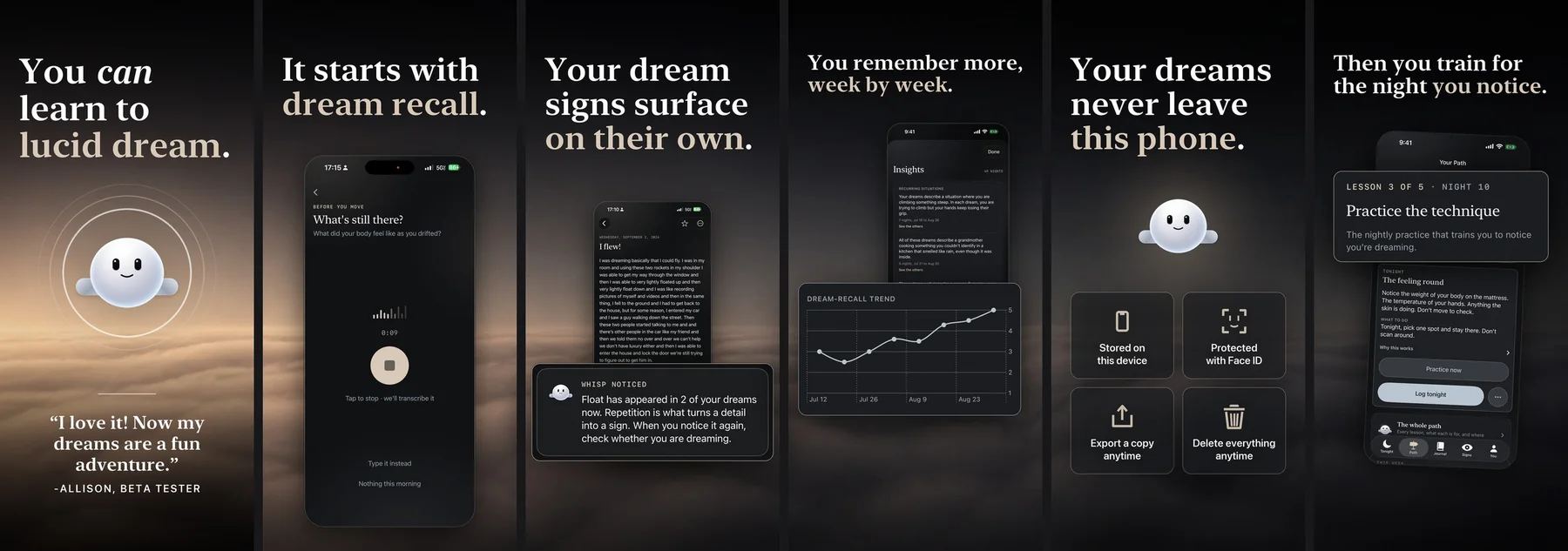
The shipped set F, as uploaded. Frame 5 is the whole privacy story in five words.
At a Glance
The whole workflow, by the numbers.
0
Servers holding a journal
0
Third-party dependencies
39k
Lines of Swift, 167 files
6
Screenshot sets before one shipped
$0 / mo
Server bill. There is no server, so there is nothing to host, nothing to breach, and nothing to shut down.
$99 / yr
Apple Developer Program, converted to an organization account under PixelNova LLC.
$0
Ad SDKs, analytics SDKs, third-party packages. Apple's App Privacy label reads Data Not Collected.
Total recurring cost to run the product: $99 a year. The privacy architecture turned out to be the cheapest one too.
Meet the Companion
Whisp
Lucid Lock's companion · Two days of art direction · Not a chatbot, not a pet
Whisp keeps people company through the quiet parts: the first morning they remember nothing, the week they nearly stop. He holds the practice, not a score. No streaks to break, no guilt. He's there, and then he's out of the way.
In the app, the celebrate reaction is reserved for one moment, the one unambiguous "you did it" when a person subscribes. Nothing else is allowed to spend it. On this page he's a little less disciplined. Tap him.
The Investment
No outside capital. Six weeks of nights, one $99 developer account, and a company formed so the app could ship under its own name.
The trade Ayden made was time for judgment: he spent it deciding what to leave out. The generated dream analysis that didn't ship, the free trial that didn't ship, the progress promises that were removed, and the server that was never built are as much the product as anything on the screen.
“AI can gladly build whatever you want, even in wildly the wrong direction. What I do is take real problems I run into and turn them into a solution. It turns out I was not the only one with the same problem.”
This is what sovereign intelligence looks like when it's small enough to ship.
Lost journal → Brand board → Whisp → Recall first → On-device patterns → Real testers → Six screenshot sets → App Store. Built by Ayden Springer, part of the same syndicate behind every case study on this page.